What's in the Box?
Few topics get people arguing like what cabinets are made of. Search for "MDF vs solid wood" and you'll find strong opinions in every direction. The honest answer is that each material has a job it does well. Here's what's in our cabinets, where each material is used, and why.
A few terms
- Solid wood is just that: lumber, the same all the way through.
- MDF (medium-density fiberboard) is wood fiber pressed with resin into a dense, perfectly flat sheet. It has no grain, so it doesn't swell and shrink with the seasons the way solid wood does.
- Veneer is real wood, sliced thin and glued to a stable core, usually MDF. It's the same wood you'd see on a solid board. It's just not an inch thick.
The box
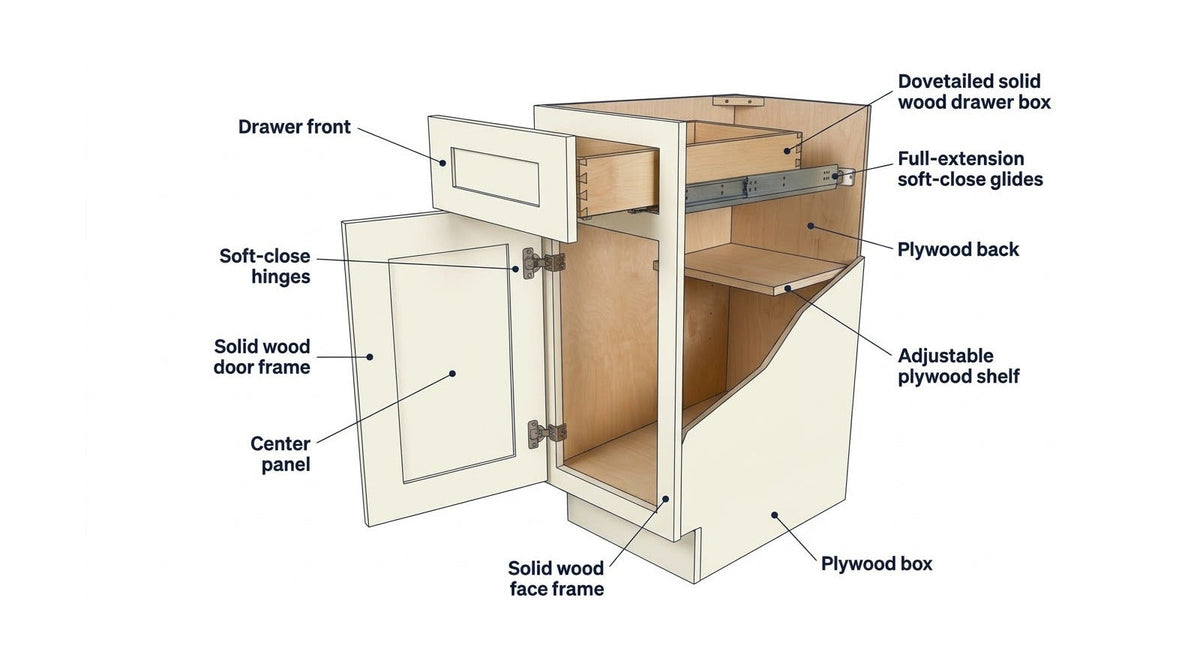
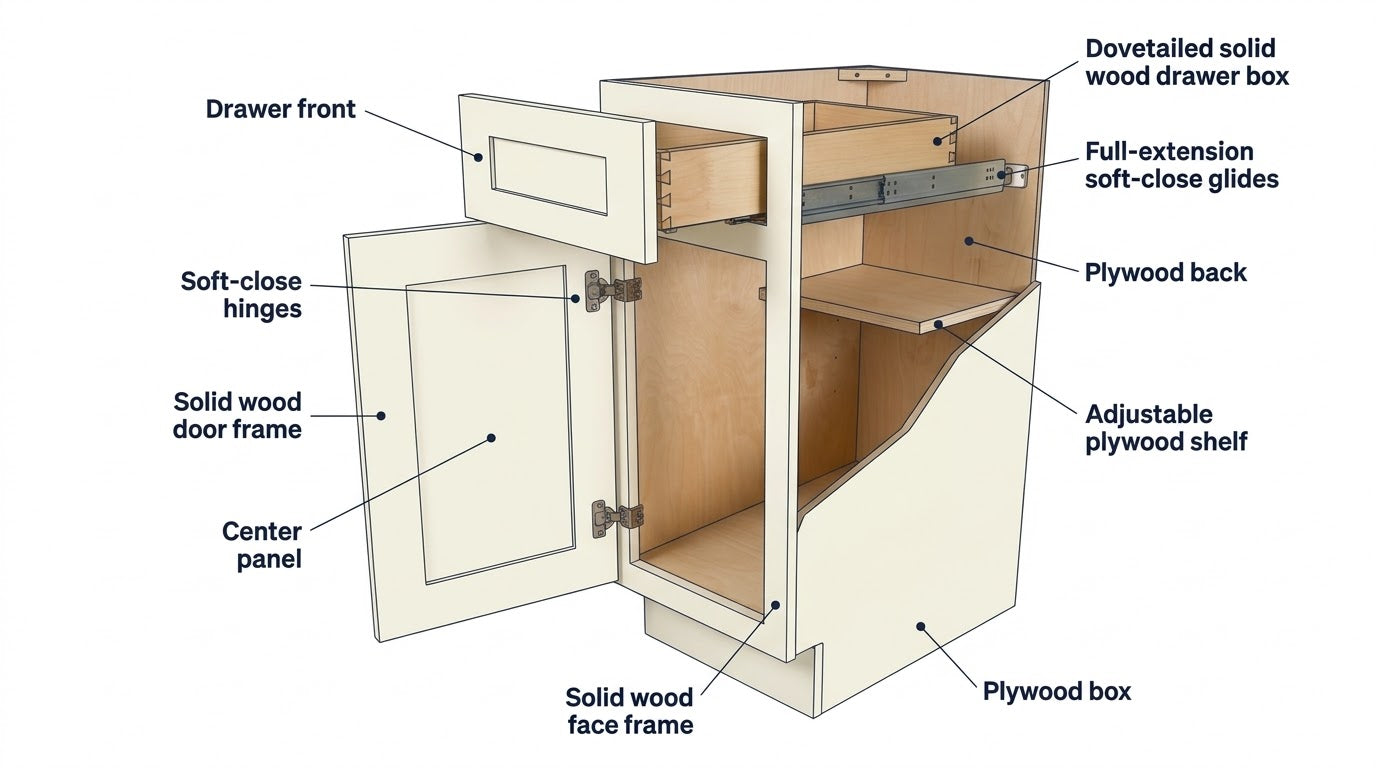
Every cabinet line we carry has a plywood box. Plywood is thin layers of wood glued with the grain crossing, which makes it strong, light for its strength, and good at holding screws.
The other common box material is particleboard, which is wood chips pressed with glue. It's flat and inexpensive, and in a dry room it can last a long time. It's heavier, it doesn't hold a screw as well, and it swells if it gets wet. That's why a plywood box is the one thing we'd tell anyone to look for, wherever they buy.
Face frames and doors
The face frame, the frame on the front of the box that the doors hang on, is solid wood on every line we sell. Our doors are five-piece: a solid wood door frame around a center panel. What changes from door to door is the panel.
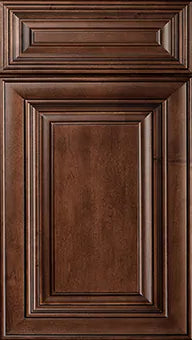
Casselberry Saddle
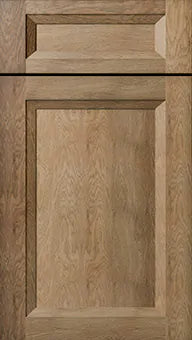
Oxford Toffee
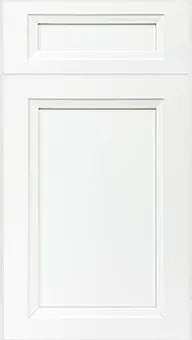
Oxford White
Solid wood center panels
Casselberry Saddle has a solid birch raised center panel. A raised panel is shaped with a profile cut into its edges, and on a stained door, solid wood shows that profile best because the grain runs all the way through.
Solid wood does move. It grows and shrinks a little with humidity, so the panel floats in the door frame to give it room. Our panels are finished before the doors are put together, so when a panel shrinks in a dry winter, there's no raw wood showing at the edge.
Veneered center panels
Most of our stained doors have a veneered center panel. The veneer is real wood, so it stains like the door frame around it.
The advantage is stability. An MDF core doesn't move, so the panel stays flat and doesn't split. On a flat shaker panel, that's a real plus.
The trade-off is water. If water gets into raw MDF and sits, it swells. Manufacturers seal and finish the panel, and its edges sit captured in the door frame where water can't easily reach them. That's a big part of why they can stand behind them with long warranties.
Painted center panels
Painted doors use an MDF center panel, the industry standard under paint. Paint shows every movement in wood, and a solid wood panel can open hairline cracks at the edges as the seasons change. MDF doesn't move, and it takes paint smoothly with no grain showing through.
Drawer boxes
Our drawer boxes are solid wood with dovetail joints, the interlocking corner joint that holds up to years of being yanked open. You'll find them on every line we carry.
Hardware
Every line comes with soft-close, 6-way adjustable hinges and full-extension, soft-close undermount drawer glides. Full extension means the drawer comes all the way out, so you can reach the back. Undermount means the glides sit hidden under the drawer instead of on its sides. Six-way adjustable hinges let the doors be lined up after install.
What about water?
This is the big worry with MDF, and it usually comes from particleboard. The swollen, crumbling sink base most people have seen is particleboard: loose wood chips and glue, often with raw edges, sitting right under the plumbing. That's the box, and ours are plywood.
MDF is a different material. It's fine fibers pressed into a dense sheet, much tighter than particleboard. On our doors it's only the center panel, and it's finished on every face, including its edges, which sit tucked inside the door frame. Splashes, steam and wiping down are just what a cabinet door sees every day, and that's what these finishes are made for.
Any cabinet material, solid wood included, will be damaged by water that sits for weeks, like a slow leak under a sink. That's a plumbing problem, not an MDF problem.
The warranty settles it
You can read arguments about these materials all day. The simplest answer is the warranty. Our manufacturers back their cabinets with industry-leading warranties, in some cases for a lifetime. Companies don't make that promise on doors they expect to fail.
From our side of the counter, we have never seen a door come back for anything other than shipping damage.
See it for yourself
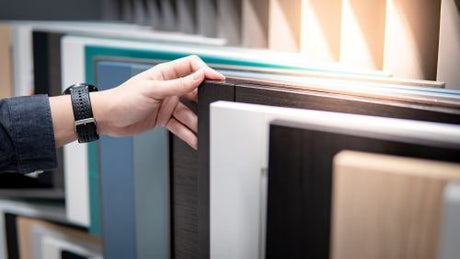
Our door samples are made the same way as the doors on our cabinets, so you can hold one, look at the panel and the joints, and see the finish in your own light. The cost of samples is credited toward your cabinet order.
Want to see the real thing?
More from the blog
What to Expect When You’re Expecting Cabinets
Cabinets ship by freight truck. Here's how delivery day goes, what to look at, and what happens if...
Read the post →
How to Get the Best Price on Cabinets (at Hopewell Cabinets or Anywhere)
The price on the website usually isn't the best price you can get. Here's how to get a...
Read the post →
The Kitchen Work Triangle (and When to Break It)
Sink, range, fridge. The real numbers behind the work triangle, when to break it, and how zones fit...
Read the post →